
Wattle Hill Journal shares practical, down-to-earth guidance on rural heritage and oast house living in the kent and sussex weald for readers across the UK.
- 0123456789
- Angle Bd Abdelmoumen & rue soumaya, Résidence
- [email protected]
Wattle Hill Journal shares practical, down-to-earth guidance on rural heritage and oast house living in the kent and sussex weald for readers across the UK.
 By James Ashdown
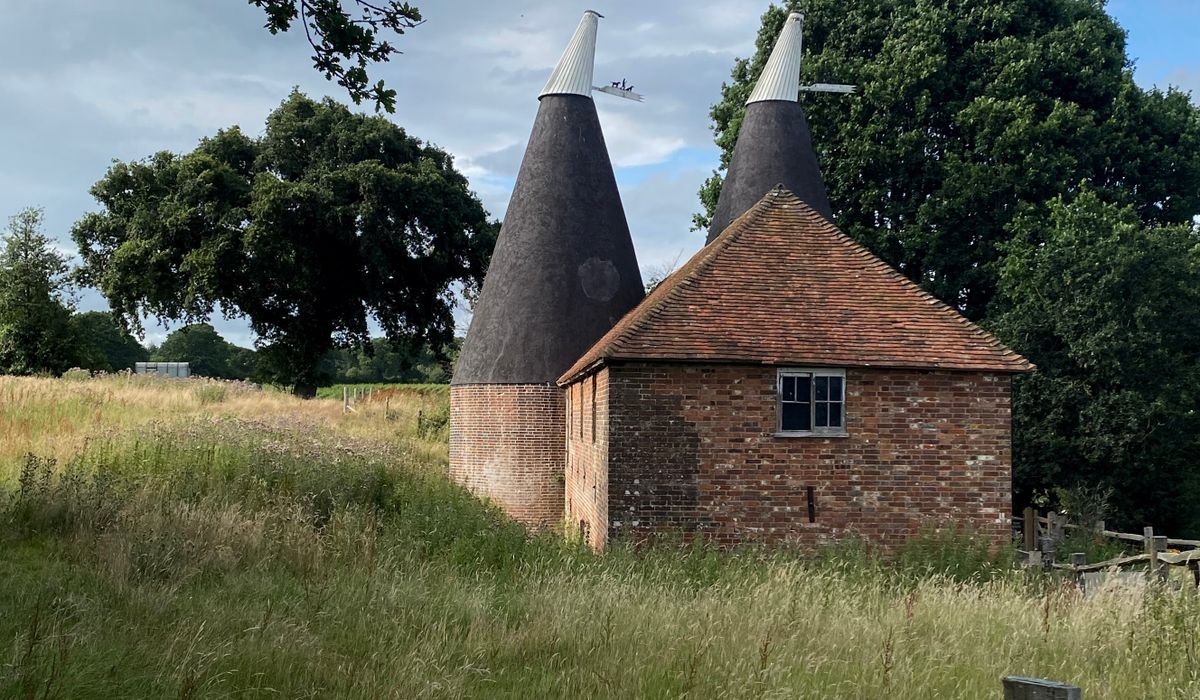
Anyone who has driven the lanes between Cranbrook, Hawkhurst and Horsmonden, or crossed into Sussex around Salehurst and Sedlescombe, will know how oast houses announce themselves. The brick roundels and their conical roofs are the giveaway, but it is the white weatherboarding on the stowage — the long barn where hops were cooled, pressed and packed — that gives these buildings their particular brightness. Arriving in the dusk, you see the white boards before you see anything else.
It looks decorative. Nearly all of it is practical, and the reasons are worth knowing whether you own one, are thinking of buying one, or simply admire them from the lane.
Weatherboarding is a rain-shedding system before it is a surface to paint. Feather-edged boards are laid horizontally with a generous overlap, so water running down the face of one board is thrown clear onto the board below, and finally off the drip edge at the bottom. Behind them, vertical battens create a cavity. Air moves through that cavity, the backs of the boards stay dry, and the wall can breathe instead of holding water against the frame.
That is why the detailing matters more than the paint. Boards are fixed with galvanised nails and left room to move, because softwood cladding swells and shrinks through the year. In the Weald, where most of our weather arrives on a south-westerly, the west and south-west elevations take the punishment. Board ends, the bottom rail and anything within splash height of the ground are the first places to fail — so they are also the first places to check each spring.
The chalk downs of Kent and Sussex gave generations of farmers an almost free source of lime, burned in small kilns and slaked on site. Mixed thin and brushed on, lime wash was cheap, quick to apply and could be renewed every year or two by anyone with a brush and a ladder. It soaked into the grain rather than sitting on top of it, and because it is mildly alkaline it discouraged mould and mildew on damp timber.
Most importantly, it was breathable. Moisture vapour could pass out through the coating instead of being trapped behind it. Weatherboarding on an oast house is also warmed from within by the kiln and dried by sun and wind, so the timber is constantly moving moisture. A breathable finish works with that movement. Modern plastic masonry paint does the opposite: it seals the surface, traps damp, and rot appears in the bottom rail before you notice anything amiss. If you are redecorating, choose a microporous masonry paint or a traditional linseed oil paint, and treat the boards as something that needs to dry outwards.
An oast house is a working drying machine. The kiln sits at the base, the drying floor above it, and the green hops were spread over horsehair cloth while warm air was drawn up through them by the cowl. The stowage alongside had to stay dry, airy and reasonably cool once the hops had come off the kiln.
White helps here in two ways. It reflects a good share of the sun's energy, so a south-facing wall stays cooler in summer and the timber works less — fewer open joints, fewer cracked boards, less draught where you do not want it. It also throws light around. On a working farm, with doors open and hops being handled, that reflected light is genuinely useful, and the pale cowls and boards make the oast easy to pick out as a landmark across a hop garden.
Hops take up taint easily. Smoke and sulphur from coke or coal-fired kilns, dust from the yard, cobwebs and insect dirt could all spoil a crop that had taken a season to grow. A white wall is an honest record: soot streaks, fly spots and grubby corners show up immediately, so the boards were easy to inspect and easy to clean. On a working oast, that mattered more than appearance. The white also made the building feel lighter and cleaner inside the stowage, where the hops were handled and packed into pockets.
Most Wealden oasts are now homes rather than working buildings, but the white weatherboarding still earns its place. It suits converted buildings because it is traditional, it sits lightly in a green landscape, and it copes with our climate when it is detailed properly. If yours is listed, or stands in a conservation area, in the High Weald National Landscape or the Kent Downs, check before changing boards, profiles or coatings.
A reasonable routine looks like this:
Get those things right and the white boards do the rest. They shrug off the rain, keep the frame dry, soften the summer sun and let an old working building look, quite rightly, as though it still has a job to do.


We are not gonna make spamming
